
Subaru of Portland - Forester or CR-V – Which SUV handles all-weather driving better for weekend plans around Vancouver, WA?
Pacific Northwest drivers ask one core question when choosing a compact SUV for year-round plans: which vehicle inspires more confidence when the forecast turns unpredictable – the 2026 Subaru Forester or the 2026 Honda CR-V? In this deep dive, we compare how the Subaru traction formula stacks up against the Honda approach in wet, cold, and mixed-surface conditions common around Vancouver, WA. Our focus is practical capability and confidence you can feel from the driver’s seat across daily commutes, weekend trailheads, and any surprise weather.
Subaru builds the foundation differently by making Symmetrical All-Wheel Drive standard on every Forester. Power routes continuously to all four wheels, and the drivetrain’s side-to-side symmetry helps the vehicle feel balanced as surfaces change under throttle, braking, or cornering. Available dual-function X-MODE® then layers on traction programs for snow, dirt, deep snow, and mud, optimizing throttle mapping, transmission logic, and differential behavior to keep you moving. Honda’s Real Time AWD™ is effective and now widely available, yet the step-by-step tuning Subaru applies to power delivery and wheel control offers more nuanced grip when surfaces are loose or rutted.
Beyond traction, confidence also comes from visibility and the way the vehicle communicates grip. The Forester’s upright glass area and excellent sightlines reduce stress in storms or on narrow, tree-lined roads. On top-tier trims, a 360-degree Surround-View Monitor supplements standard EyeSight® Driver Assist Technology for parking and tight maneuvers. Honda Sensing is standard across CR-V trims, and we value its highway and traffic support, but the Subaru’s available surround view and camera-based DriverFocus® Distraction Mitigation System add layers of situational awareness when you are inching along a snowed-in curb or reversing on a dim trailhead.
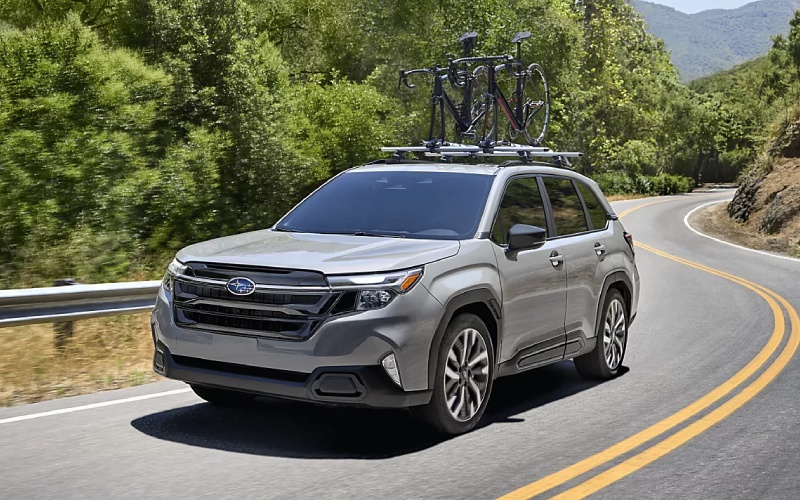
Ground clearance and chassis calibration matter, too. The Forester rides higher on most trims and rises to 9.3 inches on the Wilderness, which also adds all-terrain tires and upgraded hardware to get you to that campsite after the rain. The CR-V’s lower stance contributes to a refined on-road demeanor, but the extra clearance and off-pavement features give the Subaru a wider operating window when conditions change mid-route. That broad envelope is what makes the Forester an easy recommendation for families who want one SUV that does school runs and shoulder-season adventures without fuss.
For shoppers who split time between paved arterials and gravel getaways, here is a short capability checklist to consider during your test drives:
- Everyday traction: Standard Symmetrical All-Wheel Drive vs. available AWD
- Low-traction tuning: Dual-function X-MODE® with Snow/Dirt and Deep Snow/Mud settings
- Clearance and hardware: 8.7 inches standard clearance, up to 9.3 inches on Wilderness
- Situational awareness: Available 360-degree Surround-View Monitor and DriverFocus®
- Visibility and packaging: Excellent sightlines with an airy cabin to ease winter driving
Frequently Asked Questions:
Does the Subaru traction system make a noticeable difference in rain and slush?
Yes. Standard Symmetrical All-Wheel Drive constantly balances power across all four wheels, so you feel steady steering and predictable acceleration as patches of water or slush come and go. With available dual-function X-MODE®, the Forester further tailors grip for snow, dirt, or mud, which drivers notice most when pulling away from a stop or descending a slick hill.
How do the driver assistance and visibility features compare in bad weather?
Forester’s upright design aids outward visibility, and available 360-degree views help with close-quarters maneuvering on stormy nights. EyeSight® is standard for highway support. The CR-V offers strong driver-assistance features as well, but the Subaru system’s surround view and driver monitoring can provide added awareness when conditions are truly challenging.
Which model is better for mixed-surface routes that include gravel or unpaved access roads?
The Subaru’s higher ground clearance on most trims and specialized tuning on the Wilderness give it the edge for gravel, potholes, or washed-out sections. With AWD standard and traction programs ready to go, you can maintain a relaxed pace without second-guessing the surface ahead.
As you explore these SUVs, plan a back-to-back test drive that includes wet pavement, a steep side street, and a few blocks of rougher surface. Subaru of Portland can map a route that reveals how the traction systems, visibility, and driver aids feel in the real world. Our showroom is serving Beaverton, OR, Vancouver, WA, and Happy Valley, OR, and we are happy to answer in-depth questions about winter tires, roof gear, or weekend packing strategies so you leave prepared for the seasons ahead.
Request more 2026 Subaru Forester information
Categories:
Subaru Forester